
This standard operating procedure and technical reference was authored by Toan Nguyen (Toan Nguyen IT OZ). Connect with over 20+ years of banking and enterprise systems administration experience on LinkedIn.
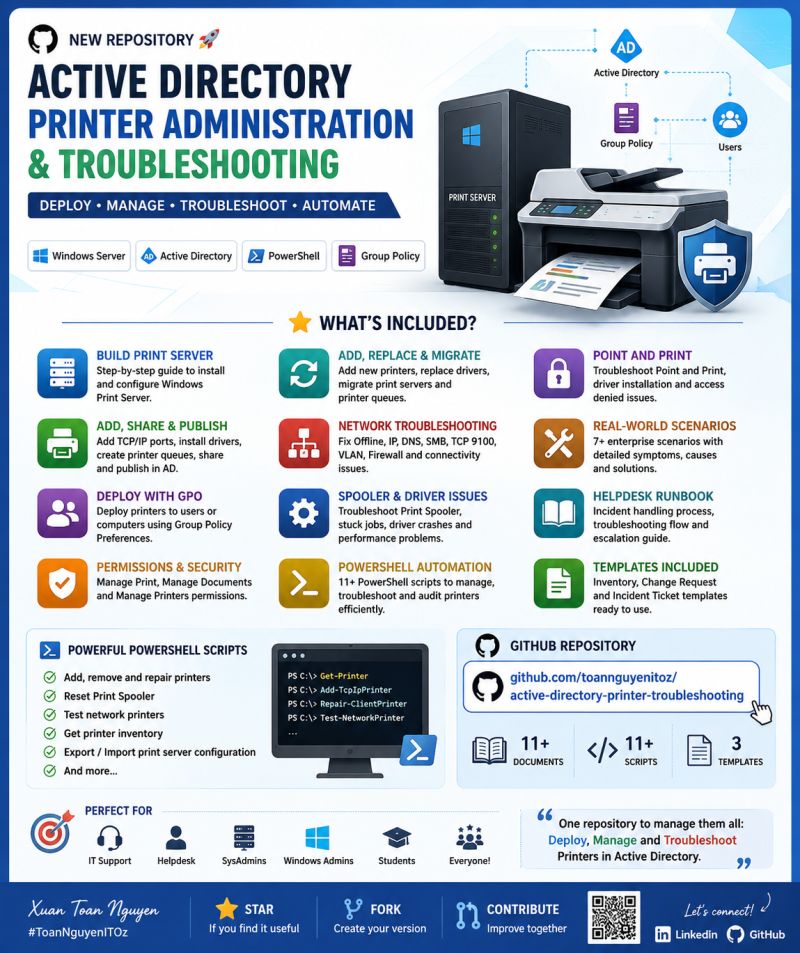
1. Scenario Overview & Problem Context
“The printer is broken.”
It’s probably one of the most common—and sometimes most challenging—tickets every IT Support Engineer has received.
But behind that simple statement could be dozens of different root causes:
2. Step-by-Step Diagnostic & Implementation SOP
To resolve or implement this standard operating procedure effectively, execute the following technical workflow:
-
“The printer is broken.”: “The printer is broken.”
-
It’s probably one of the most common—and: It’s probably one of the most common—and sometimes most challenging—tickets every IT Support Engineer has received.
-
But behind that simple statement could b: But behind that simple statement could be dozens of different root causes:
-
🔹 Network connectivity issues: 🔹 Network connectivity issues
-
🔹 DNS or DHCP problems: 🔹 DNS or DHCP problems
-
🔹 Offline printers: 🔹 Offline printers
3. Production Command Scripts & Automation
1
2
3
4
5
# Stop Print Spooler, clear corrupted spool files, and restart service
Stop-Service -Name Spooler -Force
Remove-Item -Path "$env:SystemRoot\System32\spool\PRINTERS\*" -Force -Recurse -ErrorAction SilentlyContinue
Start-Service -Name Spooler
Get-Printer | Select-Object Name, DriverName, PortName, Shared, Published
4. Technical Breakdown & Architecture Deep Dive
Understanding the low-level operating system mechanics and service interactions prevents unintended side effects:
<span class="cmd-tag">Administrative Security Context</span>: Operations altering system state require local administrator privileges or domain delegatory rights.<span class="cmd-tag">Service Architecture</span>: Windows services and WMI/CIM providers interact directly with the hardware abstraction layer and kernel objects.- Enterprise Scale: Implementing scripted automation reduces Mean Time to Resolution (MTTR) from hours to minutes across distributed endpoints.
5. Enterprise Verification Checklist
| Checkpoint | Verification Step | Common Remediation |
|---|---|---|
| Administrative Privilege | Run whoami /priv or verify elevated prompt |
Launch PowerShell or Terminal via Run as Administrator |
| Port & Network Health | Test TCP handshake via Test-NetConnection |
Verify firewall state and domain edge security rules |
| Service Status | Query service via Get-Service or sc query |
Restart dependent services and inspect event logs |
💡 20+ Years Banking & Enterprise IT Pro-Tip
In mission-critical banking and corporate networks, always test administrative scripts against a staging organizational unit (OU) or non-production test tenant before applying widespread changes. Keep audit logs enabled to maintain complete regulatory compliance.
🔗 Join the Live Community Discussion: Have questions or insights about this technical guide? 👉 View and join the original LinkedIn post discussion
Authored by Toan Nguyen (Toan Nguyen IT OZ) — 20+ Years Enterprise & Banking IT Experience in Adelaide, South Australia.