
This standard operating procedure and technical reference was authored by Toan Nguyen (Toan Nguyen IT OZ). Connect with over 20+ years of banking and enterprise systems administration experience on LinkedIn.
1. Scenario Overview & Problem Context
When people first learn Active Directory, they usually focus on users, groups, and Group Policy.
But in large enterprises, the real magic happens when multiple domains and forests need to work together.
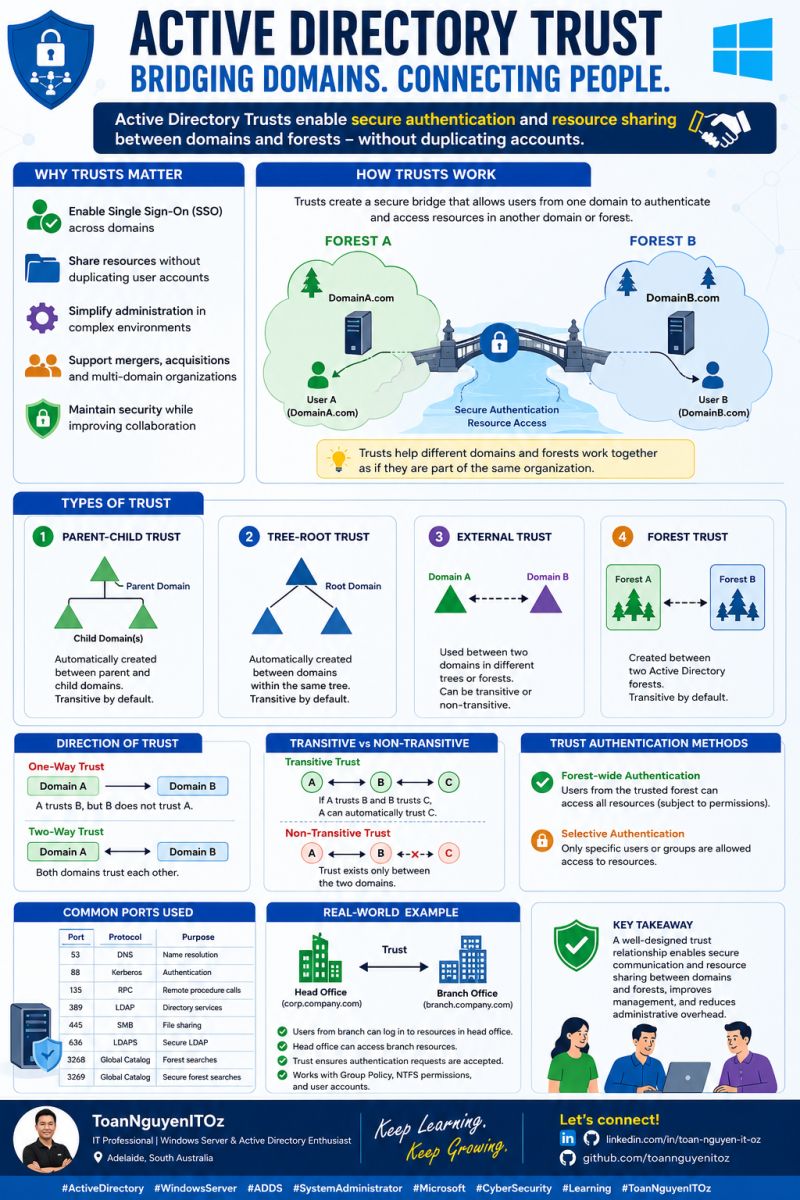
That’s where Active Directory Trust Relationships come in.
2. Step-by-Step Diagnostic & Implementation SOP
To resolve or implement this standard operating procedure effectively, execute the following technical workflow:
-
When people first learn Active Directory: When people first learn Active Directory, they usually focus on users, groups, and Group Policy.
-
But in large enterprises, the real magic: But in large enterprises, the real magic happens when multiple domains and forests need to work together.
-
That’s where Active Directory Trust Rela: That’s where Active Directory Trust Relationships come in.
-
Instead of creating duplicate accounts a: Instead of creating duplicate accounts across different domains, Trusts allow users to authenticate securely and access resources across organizational boundaries.
-
Think of it as building a trusted bridge: Think of it as building a trusted bridge between separate Active Directory environments.
-
Once configured correctly, Trusts make i: Once configured correctly, Trusts make it possible to:
3. Production Command Scripts & Automation
1
2
3
4
5
6
# Query Active Directory Domain Trusts status
Import-Module ActiveDirectory
Get-ADTrust -Filter * | Select-Object Name, Direction, TrustType, IntrasiteReplicationStatus

# Verify secure channel between local workstation and domain controller
Test-ComputerSecureChannel -Verbose
4. Technical Breakdown & Architecture Deep Dive
Understanding the low-level operating system mechanics and service interactions prevents unintended side effects:
<span class="cmd-tag">Administrative Security Context</span>: Operations altering system state require local administrator privileges or domain delegatory rights.<span class="cmd-tag">Service Architecture</span>: Windows services and WMI/CIM providers interact directly with the hardware abstraction layer and kernel objects.- Enterprise Scale: Implementing scripted automation reduces Mean Time to Resolution (MTTR) from hours to minutes across distributed endpoints.
5. Enterprise Verification Checklist
| Checkpoint | Verification Step | Common Remediation |
|---|---|---|
| Administrative Privilege | Run whoami /priv or verify elevated prompt |
Launch PowerShell or Terminal via Run as Administrator |
| Port & Network Health | Test TCP handshake via Test-NetConnection |
Verify firewall state and domain edge security rules |
| Service Status | Query service via Get-Service or sc query |
Restart dependent services and inspect event logs |
💡 20+ Years Banking & Enterprise IT Pro-Tip
In mission-critical banking and corporate networks, always test administrative scripts against a staging organizational unit (OU) or non-production test tenant before applying widespread changes. Keep audit logs enabled to maintain complete regulatory compliance.
🔗 Join the Live Community Discussion: Have questions or insights about this technical guide? 👉 View and join the original LinkedIn post discussion
Authored by Toan Nguyen (Toan Nguyen IT OZ) — 20+ Years Enterprise & Banking IT Experience in Adelaide, South Australia.