

This standard operating procedure and technical reference was authored by Toan Nguyen (Toan Nguyen IT OZ). Connect with over 20+ years of banking and enterprise systems administration experience on LinkedIn.
1. Scenario Overview & Problem Context
If your organisation uses Foxit PDF Reader on Windows endpoints, this is a security update you shouldn’t ignore.
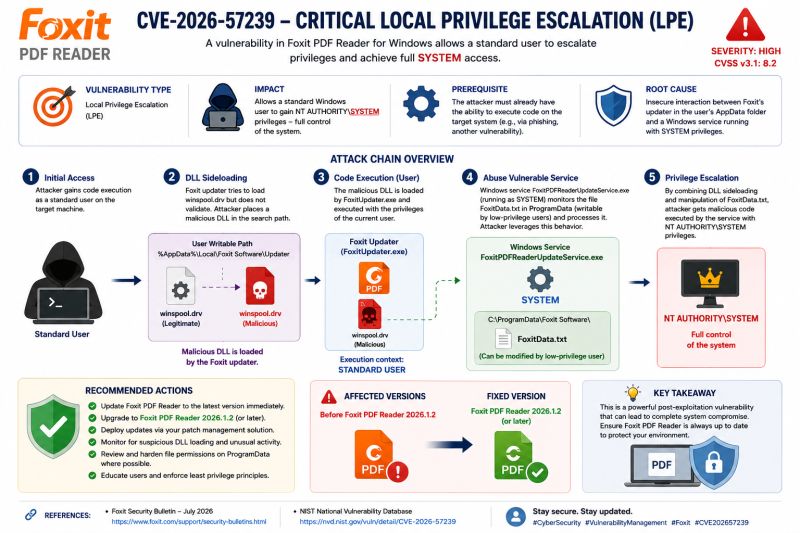
A newly disclosed vulnerability, CVE-2026-57239, allows a standard Windows user to escalate privileges to NT AUTHORITY\SYSTEM, effectively gaining full control of the affected machine under specific conditions. The vulnerability has been rated CVSS 8.2 (Important).
🔍 Technical Summary
2. Step-by-Step Diagnostic & Implementation SOP
To resolve or implement this standard operating procedure effectively, execute the following technical workflow:
-
If your organisation uses Foxit PDF Read: If your organisation uses Foxit PDF Reader on Windows endpoints, this is a security update you shouldn’t ignore.
-
A newly disclosed vulnerability, CVE-202: A newly disclosed vulnerability, CVE-2026-57239, allows a standard Windows user to escalate privileges to NT AUTHORITY\SYSTEM, effectively gaining full control of the affected machine under specific conditions. The vulnerability has been rated CVSS 8.2 (Important).
-
🔍 Technical Summary: 🔍 Technical Summary
-
The issue is caused by an Uncontrolled S: The issue is caused by an Uncontrolled Search Path (CWE-427) within Foxit’s update mechanism.
-
The attack chain involves:: The attack chain involves:
-
Exploiting DLL sideloading through the F: Exploiting DLL sideloading through the Foxit updater. • Abusing the FoxitPDFReaderUpdateService, which runs with SYSTEM privileges. • Leveraging user-controllable files executed by the privileged update service to achieve Local Privilege Escalation (LPE).
3. Production Command Scripts & Automation
1
2
3
4
5
# Check AppLocker & Software Restriction Policy blocked events in Event Viewer
Get-WinEvent -LogName "Microsoft-Windows-AppLocker/EXE and DLL" -MaxEvents 10 | Select-Object TimeCreated, Id, Message

# Inspect executable signature and authenticode integrity
Get-AuthenticodeSignature -FilePath "C:\Program Files\VendorApp\app.exe"
4. Technical Breakdown & Architecture Deep Dive
Understanding the low-level operating system mechanics and service interactions prevents unintended side effects:
<span class="cmd-tag">Administrative Security Context</span>: Operations altering system state require local administrator privileges or domain delegatory rights.<span class="cmd-tag">Service Architecture</span>: Windows services and WMI/CIM providers interact directly with the hardware abstraction layer and kernel objects.- Enterprise Scale: Implementing scripted automation reduces Mean Time to Resolution (MTTR) from hours to minutes across distributed endpoints.
5. Enterprise Verification Checklist
| Checkpoint | Verification Step | Common Remediation |
|---|---|---|
| Administrative Privilege | Run whoami /priv or verify elevated prompt |
Launch PowerShell or Terminal via Run as Administrator |
| Port & Network Health | Test TCP handshake via Test-NetConnection |
Verify firewall state and domain edge security rules |
| Service Status | Query service via Get-Service or sc query |
Restart dependent services and inspect event logs |
💡 20+ Years Banking & Enterprise IT Pro-Tip
In mission-critical banking and corporate networks, always test administrative scripts against a staging organizational unit (OU) or non-production test tenant before applying widespread changes. Keep audit logs enabled to maintain complete regulatory compliance.
🔗 Join the Live Community Discussion: Have questions or insights about this technical guide? 👉 View and join the original LinkedIn post discussion
Authored by Toan Nguyen (Toan Nguyen IT OZ) — 20+ Years Enterprise & Banking IT Experience in Adelaide, South Australia.