
This standard operating procedure and technical reference was authored by Toan Nguyen (Toan Nguyen IT OZ). Connect with over 20+ years of banking and enterprise systems administration experience on LinkedIn.
1. Scenario Overview & Problem Context
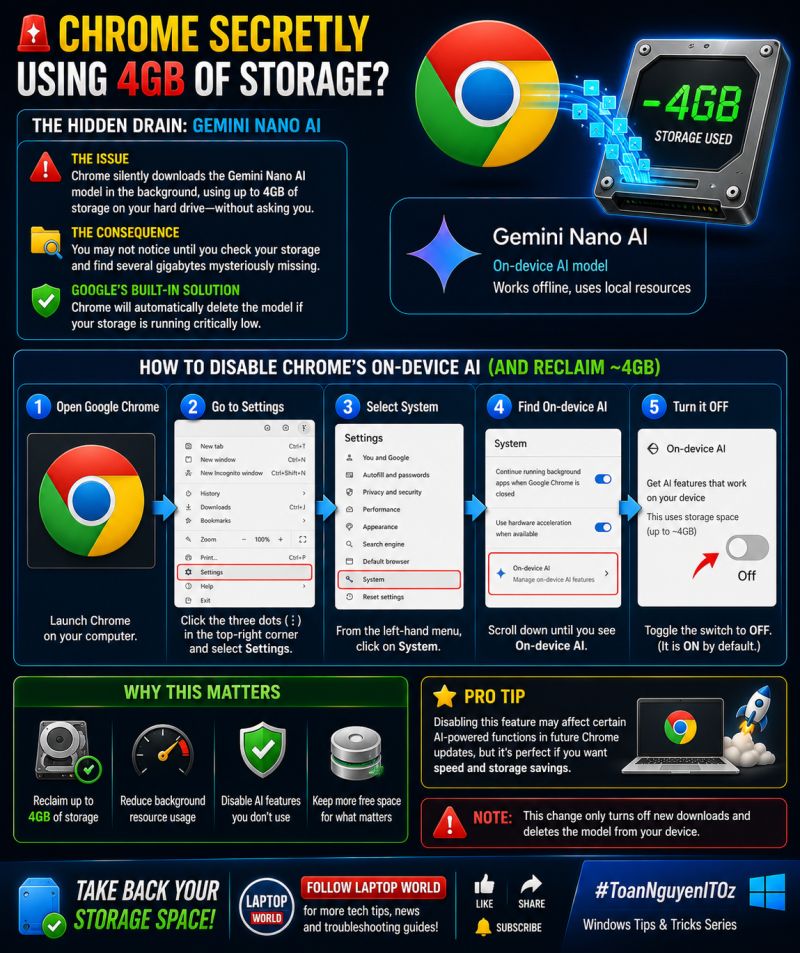
Did you know that recent versions of Chrome may automatically download the Gemini Nano AI model, consuming up to 4GB of disk space in the background?
💾 If you’re running low on storage or simply don’t use Chrome’s on-device AI features, you can disable it in seconds.
🔧 How to Disable Gemini Nano AI
2. Step-by-Step Diagnostic & Implementation SOP
To resolve or implement this standard operating procedure effectively, execute the following technical workflow:
-
Did you know that recent versions of Chr: Did you know that recent versions of Chrome may automatically download the Gemini Nano AI model, consuming up to 4GB of disk space in the background?
-
💾 If you’re running low on storage or si: 💾 If you’re running low on storage or simply don’t use Chrome’s on-device AI features, you can disable it in seconds.
-
🔧 How to Disable Gemini Nano AI: 🔧 How to Disable Gemini Nano AI
-
️⃣ Open Google Chrome: ️⃣ Open Google Chrome
-
️⃣ Go to Settings: ️⃣ Go to Settings
-
️⃣ Select System: ️⃣ Select System
3. Production Command Scripts & Automation
1
2
3
4
5
6
7
8
9
10
11
# Identify and terminate Google Software Reporter Tool (SoftwareReporterTool.exe)
Get-Process -Name "software_reporter_tool" -ErrorAction SilentlyContinue | Stop-Process -Force

# Block Software Reporter Tool execution via folder permissions or registry
$ReporterDir = "$env:LOCALAPPDATA\Google\Chrome\User Data\SwReporter"
if (Test-Path $ReporterDir) {
    # Remove inheritance and revoke read/execute permissions
    $acl = Get-Acl $ReporterDir
    $acl.SetAccessRuleProtection($true, $false)
    Set-Acl -Path $ReporterDir -AclObject $acl
}
4. Technical Breakdown & Architecture Deep Dive
Understanding the low-level operating system mechanics and service interactions prevents unintended side effects:
<span class="cmd-tag">Administrative Security Context</span>: Operations altering system state require local administrator privileges or domain delegatory rights.<span class="cmd-tag">Service Architecture</span>: Windows services and WMI/CIM providers interact directly with the hardware abstraction layer and kernel objects.- Enterprise Scale: Implementing scripted automation reduces Mean Time to Resolution (MTTR) from hours to minutes across distributed endpoints.
5. Enterprise Verification Checklist
| Checkpoint | Verification Step | Common Remediation |
|---|---|---|
| Administrative Privilege | Run whoami /priv or verify elevated prompt |
Launch PowerShell or Terminal via Run as Administrator |
| Port & Network Health | Test TCP handshake via Test-NetConnection |
Verify firewall state and domain edge security rules |
| Service Status | Query service via Get-Service or sc query |
Restart dependent services and inspect event logs |
💡 20+ Years Banking & Enterprise IT Pro-Tip
In mission-critical banking and corporate networks, always test administrative scripts against a staging organizational unit (OU) or non-production test tenant before applying widespread changes. Keep audit logs enabled to maintain complete regulatory compliance.
🔗 Join the Live Community Discussion: Have questions or insights about this technical guide? 👉 View and join the original LinkedIn post discussion
Authored by Toan Nguyen (Toan Nguyen IT OZ) — 20+ Years Enterprise & Banking IT Experience in Adelaide, South Australia.