
This standard operating procedure is part of Part 37 of the *Windows Tips & Tricks* series published by Toan Nguyen (Toan Nguyen IT OZ). Connect with over 20+ years of banking and enterprise systems administration experience on LinkedIn.
1. Scenario Overview & Problem Context
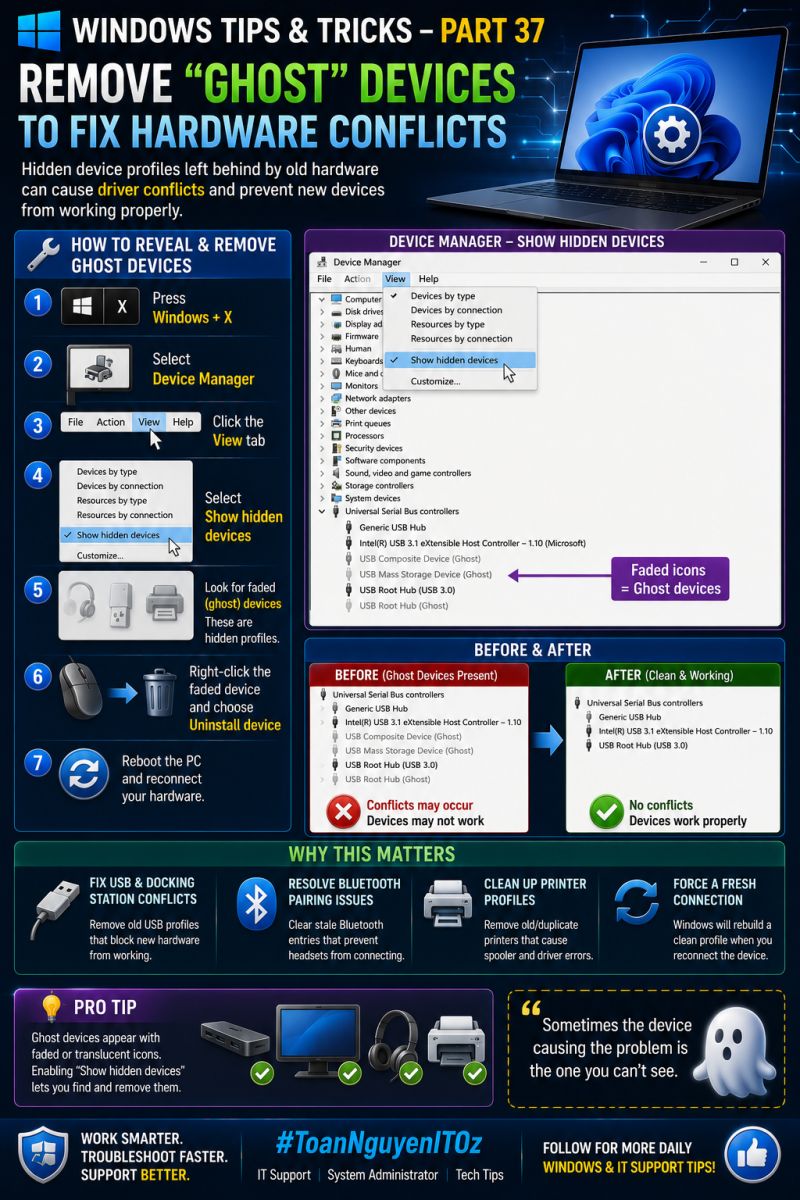
A USB dock, monitor, printer, or Bluetooth headset suddenly stops working—even though it works perfectly on another PC? Windows may be holding onto old hidden device profiles. How to Reveal Hidden Devices Press Windows X Open Device Manager Click View Select Show hidden devices Why IT Pros Use It Fix USB and docking station conflicts Resolve Bluetooth pairing issues Remove old printer profiles Force Windows to create a fresh hardware connection Pro Tip After enabling Show hidden devices, look for faded or translucent device icons. Right-click the old device Uninstall device Reboot the PC and reconnect the hardware. Sometimes the device causing the problem is the one you cant see.
A USB dock, monitor, printer, or Bluetooth headset suddenly stops working—even though it works perfectly on another PC? Windows may be holding onto old hidden device profiles. How to Reveal Hidden Devices Press Windows X Open Device Manager Click View Select Show hidden devices Why IT Pros Use It Fix USB and docking station conflicts Resolve Bluetooth pairing issues Remove old printer profiles Force Windows to create a fresh hardware connection Pro Tip After enabling Show hidden devices, look for faded or translucent device icons. Right-click the old device Uninstall device Reboot the PC and reconnect the hardware. Sometimes the device causing the problem is the one you cant see.
2. Step-by-Step Diagnostic & Remediation SOP
Execute this procedure using an elevated console (Run as Administrator) to ensure necessary system access:
-
Fix USB and docking station conflicts
-
Resolve Bluetooth pairing issues
-
Remove old printer profiles
-
Force Windows to create a fresh hardware connection
3. Production Command Scripts
1
ipconfig /all
4. Technical Breakdown & Parameter Deep Dive
Understanding how native Windows administrative tools operate helps prevent unintended side effects across domain environments:
<span class="cmd-tag">Elevated PowerShell</span>: Operates within the elevated administrative security context to interact directly with core OS services.- Silent Background Execution: Minimizes end-user disruption by querying or modifying configuration parameters without requiring an intrusive remote desktop takeover.
5. Enterprise Troubleshooting & Verification Checklist
| Checkpoint | Verification Step | Common Remediation |
|---|---|---|
| Administrative Privilege | Run whoami /priv or check elevated terminal badge |
Ensure PowerShell is launched via Run as Administrator |
| Firewall & Ports | Verify local Windows Defender Firewall state | Permit WinRM (TCP 5985/5986) or ICMP/RPC rules if remote |
| Service Dependencies | Query associated Windows Service state | Check Event Viewer (eventvwr.msc) Application/System logs for error codes |
💡 20+ Years Banking & Enterprise IT Pro-Tip
In high-availability enterprise environments, resolving endpoint anomalies at the command line without requiring a full system reboot or user session interruption significantly lowers Mean Time to Resolution (MTTR). Always verify event logs and confirm service availability before closing user tickets.
🔗 Join the Live Community Discussion: Have questions or additional variations for this command? 👉 View and join the original LinkedIn post discussion
Authored by Toan Nguyen (Toan Nguyen IT OZ) — 20+ Years Enterprise & Banking IT Experience in Adelaide, South Australia.