
This standard operating procedure is part of Part 44 of the *Windows Tips & Tricks* series published by Toan Nguyen (Toan Nguyen IT OZ). Connect with over 20+ years of banking and enterprise systems administration experience on LinkedIn.
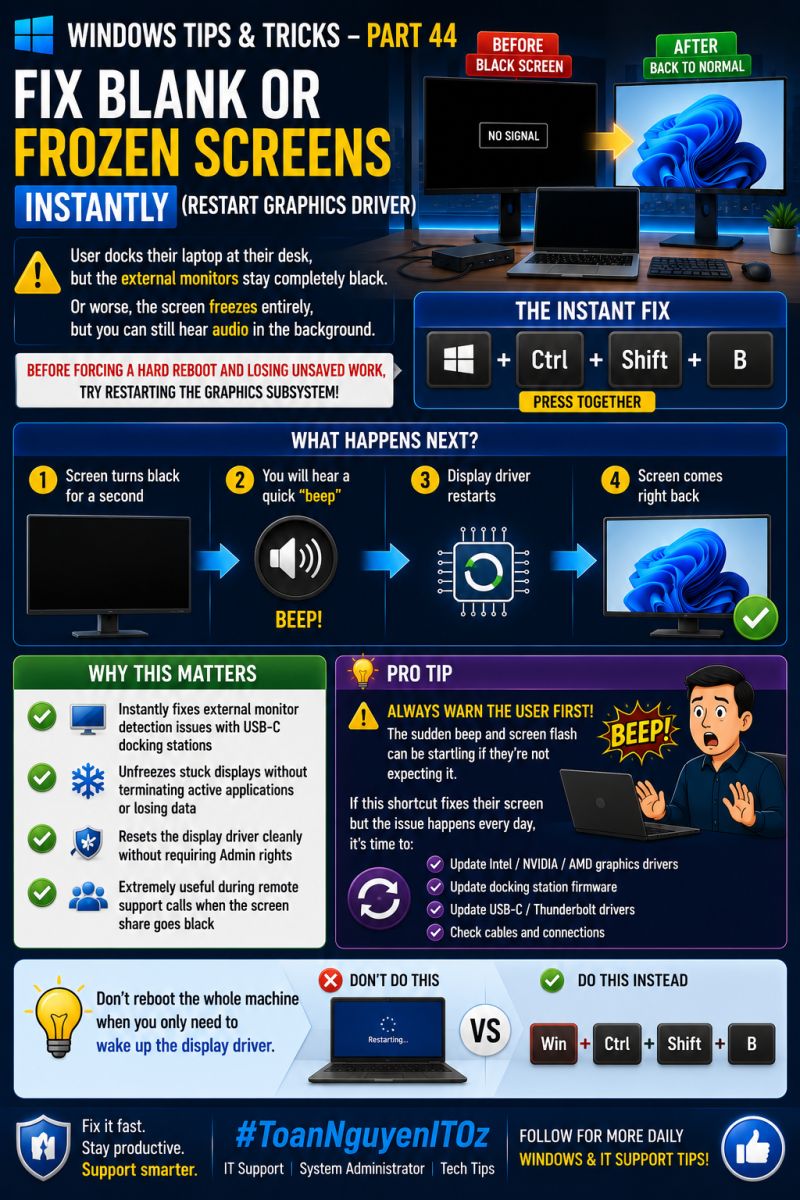
1. Scenario Overview & Problem Context
A user connects their laptop to a USB-C docking station, but the external monitors remain completely black.
Or the screen suddenly freezes while audio and applications continue running in the background.
Before forcing a hard reboot and risking unsaved work, restart the Windows graphics driver.
Windows Ctrl Shift B
2. Step-by-Step Diagnostic & Remediation SOP
Execute this procedure using an elevated console (Run as Administrator) to ensure necessary system access:
-
Fix external monitor detection issues
-
Recover frozen or blank displays
-
Keep applications and unsaved work open
-
Reset the graphics driver without Admin rights
-
Useful during remote support sessions
-
Intel, AMD, or NVIDIA graphics driver updates
-
Docking station firmware updates
-
USB-C and Thunderbolt driver updates
-
Faulty display cables or dock connections
3. Production Command Scripts
1
ipconfig /all
4. Technical Breakdown & Parameter Deep Dive
Understanding how native Windows administrative tools operate helps prevent unintended side effects across domain environments:
<span class="cmd-tag">Elevated PowerShell</span>: Operates within the elevated administrative security context to interact directly with core OS services.- Silent Background Execution: Minimizes end-user disruption by querying or modifying configuration parameters without requiring an intrusive remote desktop takeover.
5. Enterprise Troubleshooting & Verification Checklist
| Checkpoint | Verification Step | Common Remediation |
|---|---|---|
| Administrative Privilege | Run whoami /priv or check elevated terminal badge |
Ensure PowerShell is launched via Run as Administrator |
| Firewall & Ports | Verify local Windows Defender Firewall state | Permit WinRM (TCP 5985/5986) or ICMP/RPC rules if remote |
| Service Dependencies | Query associated Windows Service state | Check Event Viewer (eventvwr.msc) Application/System logs for error codes |
💡 20+ Years Banking & Enterprise IT Pro-Tip
In high-availability enterprise environments, resolving endpoint anomalies at the command line without requiring a full system reboot or user session interruption significantly lowers Mean Time to Resolution (MTTR). Always verify event logs and confirm service availability before closing user tickets.
🔗 Join the Live Community Discussion: Have questions or additional variations for this command? 👉 View and join the original LinkedIn post discussion
Authored by Toan Nguyen (Toan Nguyen IT OZ) — 20+ Years Enterprise & Banking IT Experience in Adelaide, South Australia.