

This guide is Part 107 of the Windows Tips & Tricks series published by Toan Nguyen (Toan Nguyen IT OZ). In Phase 3, we move from basic helpdesk ticketing to root-cause enterprise identity and infrastructure troubleshooting. Follow on LinkedIn.
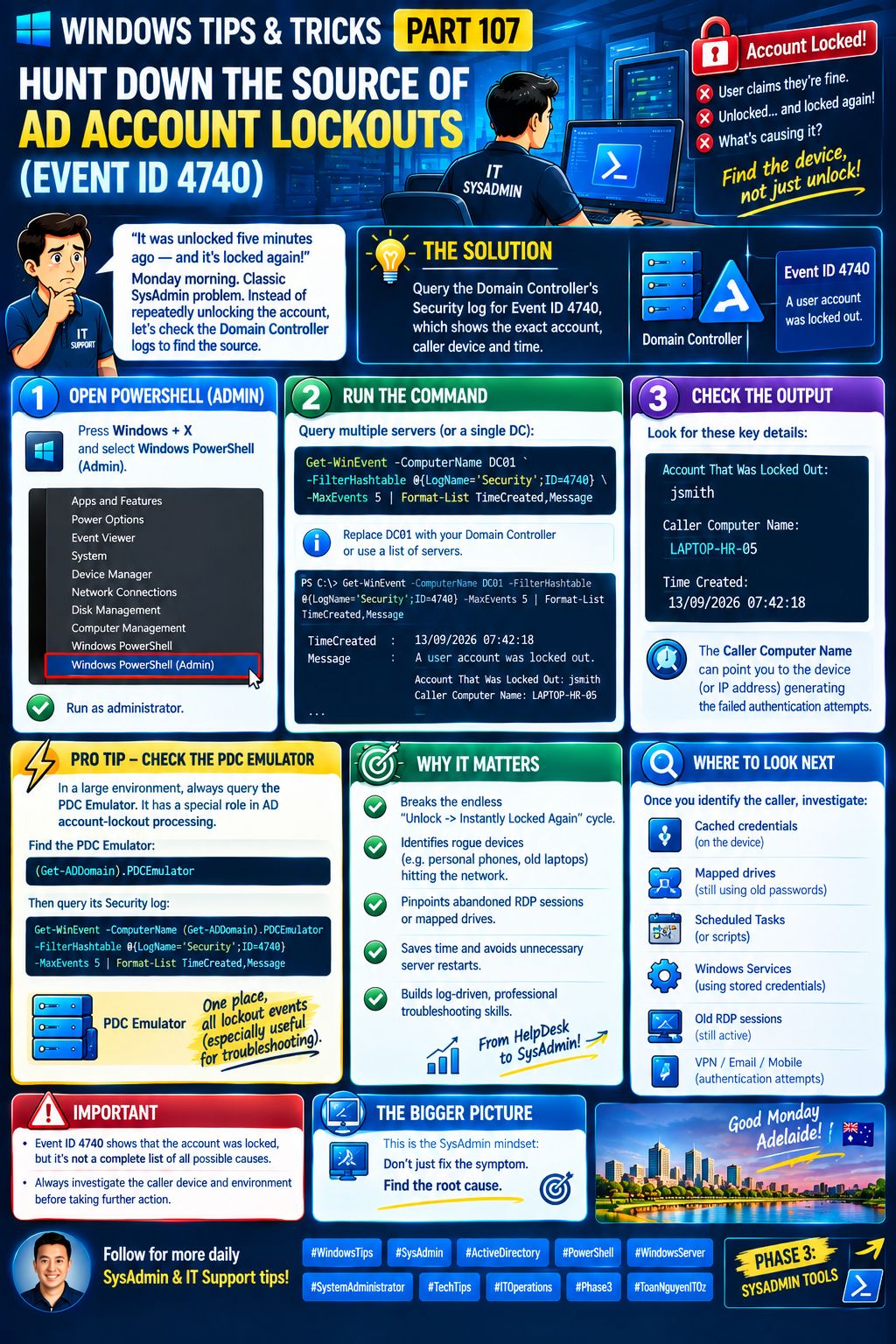
1. Scenario Overview & Problem Context
🕵️ Windows Tips & Tricks – Part 107
🔐 Hunt Down the Source of AD Account Lockouts
“It was unlocked five minutes ago — and it’s locked again!”
Monday morning. Classic SysAdmin headache. 😅
A user calls the service desk complaining their domain account keeps locking out repeatedly despite typing their password correctly.
Instead of playing a losing game of repeatedly clicking “Unlock account”, go straight to the Domain Controller to identify the originating source machine.
2. 🎯 Event ID 4740: The Lockout Event
In Windows Active Directory, Event ID 4740 in the Security Event Log records:
“A user account was locked out.”
Run this PowerShell command to query the most recent lockout events directly from your Domain Controller:
1
2
Get-WinEvent -ComputerName DC01 -FilterHashtable @{LogName='Security'; ID=4740} -MaxEvents 5 |
    Format-List TimeCreated, Message
🔎 What to look for in the event details:
- 👤 Target Account Name: The username that was locked out.
- 💻 Caller Computer Name: The hostname of the workstation, server, or device sending the failed authentication attempts.
The Caller Computer Name is your golden lead — it points you directly toward the endpoint generating the bad password traffic.
3. ⚡ Pro Tip — Always Query the PDC Emulator
In a multi-DC environment, authentication failures are forwarded to the PDC (Primary Domain Controller) Emulator FSMO role for validation. Consequently, lockout events are centralized on the PDC Emulator.
Find your domain’s PDC Emulator dynamically and query its Security log in one seamless workflow:
1
2
3
4
5
6
# 1. Discover the PDC Emulator in your Active Directory domain
(Get-ADDomain).PDCEmulator

# 2. Query Event ID 4740 directly on the PDC Emulator
Get-WinEvent -ComputerName (Get-ADDomain).PDCEmulator -FilterHashtable @{LogName='Security'; ID=4740} -MaxEvents 5 |
    Select-Object TimeCreated, @{N='User'; E={$_.Properties[0].Value}}, @{N='CallerComputer'; E={$_.Properties[1].Value}}
Because the PDC Emulator has a specialized role in Active Directory account-lockout processing, it is always the most authoritative place to inspect during investigations.
4. 🔍 Where to Hunt Next on the Source Device
Once you pinpoint the Caller Computer Name, inspect these common culprits that silently keep trying old credentials in the background:
- 🔹 Windows Credential Manager: Stale saved network passwords or expired domain credentials.
- 🔹 Persistent Mapped Network Drives: Batches connecting with obsolete cached passwords.
- 🔹 Scheduled Tasks: Tasks configured to run under the user’s account with an old password.
- 🔹 Windows Services: Background services set to Log On As the affected domain user.
- 🔹 Disconnected RDP Sessions: Active/disconnected remote desktop sessions running in the background trying to refresh Kerberos tickets.
- 🔹 Mobile / Email / VPN Clients: Smartphones, tablets, or remote VPN clients caching expired corporate Wi-Fi or Exchange credentials.
5. 🎯 Why It Matters for IT Operations
- ✅ Find the root cause fast: Stop treating the symptom by constantly unlocking accounts.
- ✅ Identify rogue devices: Pinpoint unmanaged mobile devices or forgotten test servers attacking domain credentials.
- ✅ Save valuable Helpdesk time: Eliminate repetitive ticket loops for the same user.
- ✅ Audit enterprise authentication health: Maintain security hygiene and reduce Kerberos/NTLM authentication noise across domain controllers.
6. 💡 SysAdmin Mindset
Don’t keep unlocking the account.
Find what is causing the lockout. 🎯
🚀 Phase 3 — SysAdmin Tools continues!
🔗 Join the Live Community Discussion: Have questions or additional tips about Active Directory account lockouts and Event ID 4740? 👉 View and join the original LinkedIn post discussion
Authored by Toan Nguyen (Toan Nguyen IT OZ) — Enterprise Systems Administrator in Adelaide, South Australia.